
Learning
Use a Concept Map to See How Ideas Connect
Turn a focused question into a map of concepts, labeled relationships, evidence, and useful next steps.
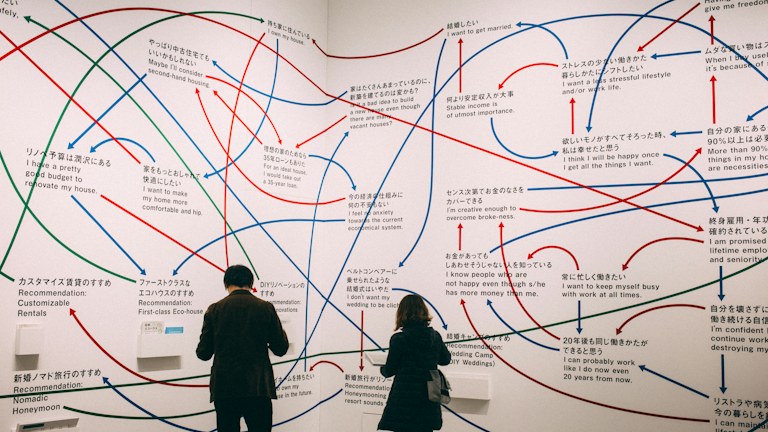
Photo: charlesdeluvio / Unsplash. Stock photograph for illustration.
In this guide
- Begin with a question that limits the map
- Collect a limited set of useful concepts
- Arrange ideas provisionally before fixing the layout
- Label connections with meaningful phrases
- Distinguish facts, interpretations, and open questions
- Look for missing links and useful cross-connections
- Explain the map aloud and revise what is unclear
- Use the finished map for a real next step
A page of notes can contain many accurate facts without showing how they relate. A concept map gives those relationships a visible form. You place a few ideas on the page, connect them, and label the connections so someone can follow your thinking. The result is useful not because it looks elaborate, but because it makes your understanding easier to inspect and revise.
You can use this approach for a chapter, a personal project, a process at work, or a topic you are trying to explain. Paper is enough. A digital canvas can help with rearranging, but the important work happens in choosing the ideas and stating their relationships. Start small so the map answers a question instead of becoming a wall of connected words.
Begin with a question that limits the map
Write one question at the top of the page. It might ask how a neighborhood newsletter reaches readers, why a character changes their decision, or how several parts of a project depend on one another. A focused question gives you a reason to include some ideas and leave others outside the map. Without it, almost anything can seem relevant.
Choose a scope you can explain in a few minutes. If your topic is broad, map one part first. For example, planning a community event contains many systems, but you might begin with how registration information reaches the people preparing the venue. A small accurate map provides a stronger foundation than a large one whose connections are mostly vague or assumed.
Collect a limited set of useful concepts
List the main ideas before drawing connections. Use short labels that name an actual concept, object, stage, or role. Avoid copying whole paragraphs into boxes. If a label needs a long explanation, place that explanation in a separate note and keep the map itself readable. The map should help you see structure at a glance.
Choose perhaps a handful of core concepts for the first draft rather than trying to include every detail. Read through the list and remove duplicates or labels that mean nearly the same thing. If two concepts seem similar but are importantly different, write down the distinction. That small act of clarification can reveal more about your understanding than adding another branch to the page.
Arrange ideas provisionally before fixing the layout
Place the broadest or most central concept where it is easy to find. Arrange related ideas nearby, leaving space for connections and changes. There is no need to make the first layout beautiful. Sticky notes or lightly written labels make it easier to move things when you discover that the initial arrangement does not reflect the relationships well.
Try more than one organizing pattern if necessary. A process may read naturally from left to right, while a topic with several interacting parts may work better around a central idea. Let the subject determine the arrangement. Do not force everything into a tree if some relationships cross between branches. The structure should represent the topic, not merely imitate a diagram you have seen before.
Label connections with meaningful phrases
Draw a line between two concepts only when you can explain the relationship. Add a short phrase such as depends on, produces, is an example of, or is revised by. Then read the connection as a sentence. Registration list is checked by coordinator is a claim you can examine. A line labeled related to tells you much less.
Pay attention to direction. If one item supplies information to another, show which way the information moves. If the relationship works both ways, explain each direction when the meanings differ. Avoid using arrows as decoration. A viewer should be able to tell whether an arrow represents sequence, influence, responsibility, or something else from the words attached to it.
Distinguish facts, interpretations, and open questions
Some connections will come directly from a source or an observed process. Others may be your interpretation. Mark that difference in a simple way, such as a note beside the connection. You can also keep unanswered questions in a separate area. This prevents a neat diagram from making uncertain claims appear more settled than they are.
If you are mapping material from a book, article, or meeting, keep enough source information to revisit the relevant passage. A page number or a short reference may be sufficient for personal notes. When a connection is disputed, return to the evidence rather than moving boxes until the diagram looks convincing. The map should expose uncertainty so you can investigate it, not conceal it behind confident lines.
Look for missing links and useful cross-connections
Read the map along several paths. Can you explain how one stage leads to another, or have you skipped an essential step? Are two clusters isolated because they are genuinely separate, or because you have not yet considered the relationship? A missing link can show where you need another question, another source, or a conversation with someone who understands the process.
Cross-connections can be especially revealing. A resource may support several stages, or a decision in one area may change work elsewhere. Add those links when you can describe them precisely. Do not connect every box to every other box merely to make the map look sophisticated. A crowded network of weak relationships makes the important ones harder to see.
Explain the map aloud and revise what is unclear
Walk through the map as though you were showing it to someone new to the topic. Start with the question and follow the most important relationships. Notice where you need to add an explanation that is not represented anywhere. That may mean a label is too vague, a connection is missing, or the map is trying to cover too much at once.
If another person reviews it, ask them to describe one path back to you. Their interpretation can reveal ambiguity you no longer notice because you already know what you meant. Listen for confusion about arrows, terminology, or sequence. Revise the map to make the meaning clearer, rather than relying on your spoken explanation to repair the same problem every time.
Use the finished map for a real next step
A concept map becomes valuable when it helps you do something. Use it to outline a piece of writing, prepare questions for further reading, plan a project handover, or check what you remember without looking at the source. Choose the next action based on what the map reveals. If a cluster is poorly understood, study that part instead of rereading everything equally.
Date the map and keep earlier versions when the changes are informative. Understanding develops, and a revised relationship is often a sign of progress rather than evidence that the first attempt was worthless. Stop adding detail when the map answers its question clearly. You can create another map for a narrower issue later. The strongest result is a readable explanation of relationships you can support, question, and use.